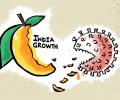
Those hardest hit by the second wave of the pandemic have been blue-collared workers, doctors and healthcare workers, law and order and municipal personnel, individuals eking out daily livelihood, and small businesses. And there should be more measures taken to alleviate their pain, the Reserve Bank of India (RBI) said on Monday. The report also indicated that the RBI's growth numbers might have to be revisited as the central bank's real GDP growth projection of 26.2 per cent given in the MPC's resolution of April 7 for the first quarter of 2021-22, were "made before the full fury of the resurgence." Nevertheless, the "resurgence of COVID-19 has dented but not debilitated economic activity in the first half of Q1: 2021-22.
The Reserve Bank of India (RBI) is precariously balancing two opposing objectives - maintaining easy financial condition in the domestic market, while ensuring external stability - and economists have started taking note. They say India is going through the classic trilemma of the 'Impossible Trinity'. The RBI cannot have an independent monetary policy (setting domestic interest rates) in an environment of an open capital account and flexible exchange rates. What is even more complicated for the central bank now is that financial market stability overlays all the other three objectives.

Historically, Tata Steel has always been among the biggest companies in the group in terms of m-cap, revenue, and profit but its fortunes began to decline after 2010 due to a sharp decline in the profitability of its European operations that it had acquired in 2007. The company was hit by a sharp rise in its debt level after this acquisition. First, it lost out to Tata Motors in terms of revenue in FY11 and then in March 2015, Titan beat it to become the third-biggest firm in the group in terms of m-cap. In FY20, TCS reported higher revenue and Tata Steel had become the third biggest company in that terms.

The group companies now lead the market capitalisation league table in sectors such as ports, power generation, gas distribution and transmission, and power transmission and distribution, ahead of incumbents in both public and private sector. This has Gautam Adani family the second wealthiest in business in India.

Theoretically, the currency with the public should expand in sync with the nominal income, which again moves in relation to the nominal growth rate of the economy. But the correlation breaks easily when other factors come into play, says Anup Roy.

Overall, Tata Steel becomes the seventh non-financial firm, including four oil PSUs to report quarterly revenues of Rs 50,000 crore.

Covid-19, US yields, dollar to weigh on equity flows in the near term.

Earnings growth in the early-bird sample has been driven by banks and iron & steel companies.

Although such alerts are not compulsory for the banks, this may become the norm now if payments are missed even for a day.

New-generation private sector banks such as ICICI, HDFC, Axis, Kotak etcetera owe their existence to the recommendations of the first Narasimham Committee.

However, experts caution that investors should not expect the big returns they got from the sector between March and September 2020.

Together with its share buyback worth Rs 16,000 crore completed in January this year, TCS shareholders will receive a record Rs 30,250 crore from their company in FY21.

The earnings are, however, expected to be down around 2 per cent on a sequential basis due to pent-up demand getting exhausted and the adverse impact of rising metals and energy prices on consumer goods and manufacturing companies.

The sudden movement of the rupee - post the monetary policy - is not a reason to panic, said currency dealers. According to them, a correction was overdue for the rupee that remained the best performing currency in the region for well over a month. The rupee closed at 74.72 a dollar on Friday from its previous close of 74.60. It had dropped 1.52 per cent against the dollar on April 7 after the Reserve Bank of India (RBI) announced its monetary policy, committing to buy Rs 1 trillion of bonds in the June quarter. A weak rupee goes well with the export narrative of the government, and is consistent with the RBI's intervention strategy that prevented an appreciation.

For development finance institution to succeed now, the government must stand like a rock behind it and be patient.

If the data breach is found to be genuine, and if the company is found guilty on the grounds of dereliction of duty, or misleading the general public and the RBI about the data breach, actions taken against it will be severe, the person quoted above said.

India Inc's cash pile was up 13.8 per cent last fiscal year, thanks to a combination of higher profits in sectors such as IT and fund raising by top companies such a Reliance Industries, Bharti Airtel and Tata Motors, among others.

Bank of America (BofA) Securities expects India to be the third-largest economy in the world by 2031. The economic rise could become a reality by 2028, but the Covid pandemic delayed the pace, BofA Securities economists Indranil Sen Gupta and Aastha Gudwani wrote in a report.

In the state of the economy report, the RBI said bond vigilantes could undermine the recovery, unsettle financial markets, and trigger capital outflows from emerging markets.

In India, it is not easy to fight it out with the large banks which are nimble-footed and technology-savvy and are continuously innovating on the retail turf with newer products for customer acquisition.
 © 2025 Rediff.com - Investor Information - Advertise with us - Disclaimer - Privacy Policy - Sitemap - Feedback - About us - Terms of use - Grievances